


It is 10 PM on a Tuesday and your phone buzzes with a photo that makes your heart stop. Your favorite client has swollen, red, itchy eyelids that look like she went ten rounds in a boxing ring. We have all been there, lash bestie. That cold sweat and the instant panic of "did I mess up?" is the absolute worst part of the lash game. You are terrified of a lawsuit or losing a loyal regular, and the internet is usually zero help. Knowing exactly what to do when a client has an allergic reaction is the difference between a professional powerhouse and a hobbyist who folds under pressure.
A May 2026 retrospective study found that 23.44% of patients with cosmetic reactions experience incomplete recovery, including permanent issues like hyperpigmentation. That is a massive deal for your reputation. You need a protocol that protects your client and your business immediately. This guide is your ultimate survival manual. We are going to master the science of cyanoacrylate, the new May 2026 FDA fragrance labeling rules, and the exact steps to manage the drama with total boss confidence. You will learn to spot the difference between a chemical burn and a true allergy so you can stop guessing and start leading. Let us get you prepared to handle anything the lash world throws your way.
Key Takeaways
- Differentiate between a true cyanoacrylate allergy and a chemical burn so you can troubleshoot like a pro instead of panicking.
- Get the "no-nonsense" emergency protocol for what to do when a client has an allergic reaction to handle the situation with total authority.
- Understand the "Removal Dilemma" and why hitting the solvent too early can actually trigger a massive fume overload on sensitive eyes.
- Learn the exact communication strategy to manage unhappy clients and protect your business from liability without giving away freebies.
- Future-proof your lash game by switching to UV systems and using nanomisters to lock in fumes and stop reactions before they start.
Identifying the Issue: Is it a True Allergy or a Chemical Burn?
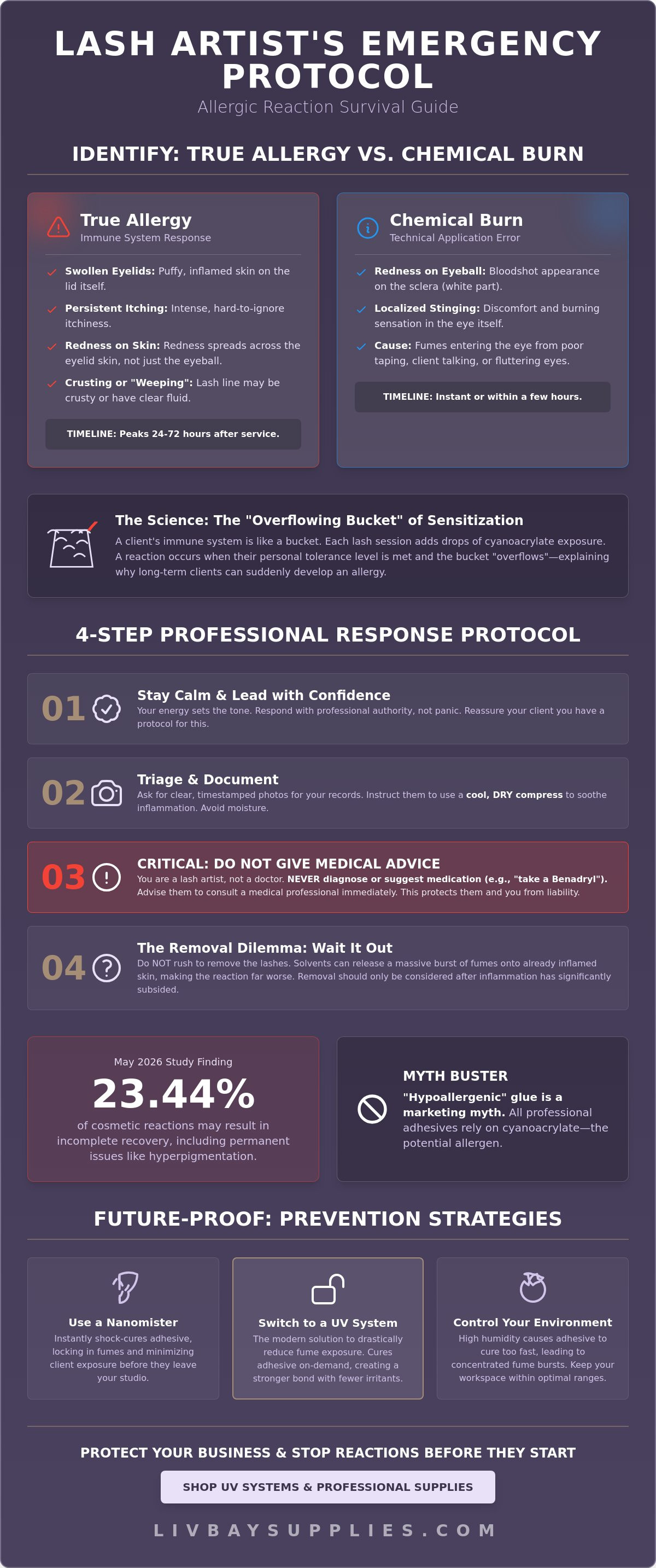
Stop playing guessing games with your client's eyes. When that frantic text hits your phone at midnight, you need to know exactly what to do when a client has an allergic reaction versus a chemical burn. These are two completely different beasts. A chemical burn is usually a technical error. It happens when fumes sneak into the eye because of poor taping, improper mapping, or a client who won't stop chatting during the service. An allergy is an immune system revolt. It's deep, it's internal, and it's much harder to fix with just a nanomister.
Let's get one thing straight: "hypoallergenic" lash glue is a total myth. If a brand tells you their professional adhesive is allergy-proof, they're lying to your face. Every professional adhesive on the market relies on cyanoacrylate to create that rock-solid bond we're obsessed with. While some "sensitive" formulas swap out certain ingredients, the core chemistry remains the same. If your client is sensitive to the bond, they're at risk. Period.
The Science of Cyanoacrylate Sensitization
Think of your client’s immune system like a bucket. Every time you apply lashes, a few drops of exposure go into that bucket. For most, the bucket is huge and never overflows. For others, their body eventually decides it has had enough. This is called sensitization. It explains why a loyal regular who has been seeing you for three years can suddenly wake up with "sausage lids" after a routine fill. They didn't suddenly get a "bad batch" of glue; their bucket just finally overflowed.
Your environment plays a massive role here too. High humidity makes cyanoacrylate cure faster, which sounds great for your speed, but it can also lead to a concentrated burst of fumes. If those fumes sit on the skin before they fully polymerize, you're looking at a high-speed ticket to an allergic skin reaction to cyanoacrylate. It's a cumulative game, and as a boss babe, you have to track these changes over time.
Symptom Checklist: Burn vs. Allergy
You have to be a lash detective. If the redness is strictly on the white of the eyeball, you're likely looking at a chemical burn from fumes. This usually happens instantly or within a few hours. However, true allergic reactions follow a 48-hour window. If they're fine on the day of but wake up two days later with intense itching and "crusty" lash lines, their immune system has officially entered the chat. Use this quick checklist to spot the difference:
- Chemical Burn: Redness on the eyeball, localized stinging, usually clears up in 24 hours.
- True Allergy: Swollen eyelids, persistent itching, redness on the skin, and "weeping" or crusting.
- The Timeline: Burns happen fast; allergies peak between 24 and 72 hours post-service.
Contact dermatitis in the context of lash extensions is a localized immune response triggered by direct skin contact with adhesive components, resulting in inflammation of the eyelid tissue. If you see this, you aren't just dealing with a "sensitive" day; you're dealing with a technical challenge that requires a professional protocol.
The Professional Response Protocol: What to Do Immediately
When that SOS text hits, your adrenaline is going to spike. Breathe. Your energy is the thermostat for the entire situation. If you freak out, your client assumes the worst. You need to step into your CEO shoes and lead. Knowing exactly what to do when a client has an allergic reaction starts with a calm, scripted response that prioritizes their safety and your professional reputation. This isn't the time for "I'm so sorry" or "I don't know what happened." It's the time for action.
The golden rule? You are a lash artist, not a medical professional. Never diagnose. Never suggest they "just take a Benadryl." If you give medical advice and things go south, you are wide open for a lawsuit. Instead, point them toward a medical overview of contact dermatitis and insist they speak with a doctor. Your job is to manage the lashes; the doctor's job is to manage the body.
Step-by-Step Client Triage
The second the report comes in, start your triage. Ask the client for a clear, timestamped photo of both eyes in natural light. You need this for your records and your insurance provider. If they are experiencing active itching or heat, instruct them to use a cool, dry compress. This helps soothe the immediate inflammation without introducing moisture that could shock-cure any lingering adhesive fumes.
Enforce the "No-Touch" rule immediately. Clients want to rub, pull, or pick at the extensions when they feel irritation. This is a recipe for disaster. Rubbing can push allergens deeper into the skin or cause micro-tears that lead to secondary infections. Remind them that their hands carry bacteria that will only make the "inflammation station" worse. Keep it professional, keep it firm, and keep it documented.
The Emergency Consultation
If the photos look intense, hop on a quick FaceTime call. A 30-second video check allows you to see if the swelling is localized to the lid or if the eyeball itself is involved. This is where your pro lash kit documentation becomes your best friend. Show them your intake forms and the high-quality, professional-grade products you used. It proves you followed industry standards and didn't use "basement-tier" supplies.
If the swelling is obstructing their vision or they feel "throat tightness," do not wait. Tell them to head to Urgent Care immediately. For most, it's just a localized reaction that a doctor can treat with a topical. While they wait for medical clearance, you can suggest they gently cleanse with a professional lash cleanser foam to remove any environmental irritants or pollen that might be hitching a ride on those new sets.
The Removal Dilemma: To Strip or Not to Strip?
Your first instinct is to get those lashes off immediately. Stop. Think. While removing the trigger is standard advice for most allergies, lash extensions are a different beast. When you apply a professional solvent to a fresh set, you're effectively de-polymerizing the adhesive. This process releases a massive spike of concentrated fumes. On a normal day, it's fine. On an eye that's already red and inflamed, it's a chemical nightmare. Knowing what to do when a client has an allergic reaction means weighing the risk of fume overload against the discomfort of the lashes.
If you rush into a removal while the skin is actively weeping or swollen, you risk pushing that solvent into the micro-cracks of the irritated skin. This can lead to even more intense swelling or a secondary chemical burn. It's a catch-22 situation that requires a calm, technical assessment before you touch your tweezers. You aren't just a lash tech; you're a professional who understands chemistry and skin health.
When Removal is Mandatory
Sometimes, you don't have a choice. If the client reports extreme pain, visible pus, or if the lashes are physically poking into the swollen tissue, they have to go. In these high-stakes moments, ditch the liquid or gel removers. Use a thick, cream-based remover. It stays exactly where you put it and won't migrate into the eye. Ensure the client's eye is sealed tighter than a vault. Any gap in the tape will let those reactivated fumes straight onto the eyeball, turning a bad day into a catastrophic one. Work in small sections and move fast to minimize exposure time.
The Alternative: Letting Them Shed
If the reaction is mild, the safest bet is often the "wait and see" approach. Instead of a full chemical removal, instruct the client to wash their lashes twice a day with a high-quality lash cleanser. This helps physically rinse away residual fumes and carbon black particles that might be sitting on the lash line. It's a slower process, but it avoids the "fume bomb" of a professional removal. Most irritation from fumes will begin to settle once the adhesive is fully cured and the lashes are clean.
Be real with your client about the timeline. Tell them it might take 48 to 72 hours for the swelling to subside once the initial exposure is neutralized. If they can't handle the wait, you can perform a "gentle pick" removal. This involves using two pairs of tweezers to carefully "banana peel" the extensions off without using any chemicals at all. It's tedious. It takes time. But it's the ultimate move for a boss babe who wants to protect her client's skin at all costs. This level of care is what separates the industry leaders from the amateurs.
Managing Client Relationships and Business Liability
Handling the fallout of a reaction is where you prove you are a CEO, not just a tech. When a client is upset, it is easy to get defensive or start apologizing profusely. Do not do that. Over-apologizing can sound like an admission of fault. In the professional world, knowing what to do when a client has an allergic reaction means balancing empathy with iron-clad business boundaries. You are a professional providing a service with known risks. If you followed every protocol, you are not a "bad artist." You are just dealing with a biological reality.
The "No Refund" rule is your biggest shield. Refunding the service cost is often seen by insurance companies as an admission of guilt or negligence. It says, "I did something wrong, here is your money back." Instead, offer a free professional removal once the inflammation subsides. You can also offer a credit toward a different service that does not involve cyanoacrylate, like a brow lamination. This keeps the client in your ecosystem without risking their eye health further.
The Legal Safety Net
Your waiver is your best friend. If it does not explicitly mention cyanoacrylate and the risk of cumulative sensitization, update it today. Every full set eyelash extensions appointment must begin with a signed, dated consent form that acknowledges these risks. Keep a meticulous "Client History Log" that notes the humidity, the specific adhesive batch used, and the application style. If a legal issue ever arises, this data proves you are a high-level professional who tracks every detail of their craft.
Professional liability insurance is non-negotiable. Do not wait until a client threatens a lawsuit to find out what your policy covers. Most basic salon insurance requires you to follow manufacturer instructions to the letter. This is why using high-quality, documented supplies is a must for your protection. Check out our professional lash tech tools to ensure you are working with the best in the industry.
Communication Scripts
When the "emergency" text comes in, use a script to keep your cool. A boss babe response looks like this: "Hey babe, I am so sorry to hear your eyes are feeling irritated. Based on the photos, it looks like your immune system is reacting to the adhesive. Your safety is my top priority, so we cannot do any more lash services for now. Please follow up with your doctor for a medical assessment. I am here to help with a safe removal once they give you the green light."
What about the "But I have a wedding!" client? Be firm. If they have reacted once, the next reaction will almost certainly be faster and more severe. "No" is a complete sentence when it comes to client safety. Explain that you value their vision more than a single set of lashes. This level of integrity often turns a frustrated client into a lifelong fan who trusts your professional judgment implicitly.
Future-Proofing: How to Prevent Reactions in 2026
Don't wait for a disaster to hit before you decide to upgrade your game. By the time you are frantically searching for what to do when a client has an allergic reaction, you are already in damage control mode. In the 2026 lash landscape, the most successful artists aren't just reacting to problems; they are deleting them before they start. Prevention is the ultimate flex for any boss babe who wants to protect her reputation and her bottom line. You need to be obsessed with your setup and your supplies to keep those "sausage lids" at bay.
Patch tests are a major point of confusion in our industry. Let's be real: they are often a total security blanket that doesn't actually provide security. Because allergies to cyanoacrylate are cumulative, a client might pass a 24-hour patch test today and still develop a massive reaction after six months of fills. Instead of relying on a tiny drop of glue behind the ear, you need to focus on reducing total chemical exposure during every single set. This means using a nanomister to shock-cure the adhesive at the end of the service. This locks in those spicy fumes instantly so they don't sit on the skin for the next 24 hours.
The UV Revolution: A Game-Changer for Sensitive Clients
If you haven't looked into UV/LED lash systems yet, you are playing yourself. This is the most revolutionary shift we have seen in years. These systems use a specific light frequency to cure the adhesive in roughly 1 second. This tech reduces cyanoacrylate fume exposure by a massive 90% compared to traditional air-cured glues. When the bond is instant, the "fume window" is basically non-existent. You can finally stop worrying about your client's shower schedule and start offering sets to people who thought they were retired from the lash life. Transitioning your sensitive babes to lash technologies like this is a total power move.
Even if you aren't ready for UV, you must invest in the best eyelash glue with low-fume profiles. High-quality adhesives are formulated with better purity standards, which is critical now that the May 2026 FDA fragrance labeling rules are in full effect. You need to know exactly what is in your bottle. No more "mystery" ingredients. Just pure, high-performance bond that keeps your retention insane without the irritation.
Salon Environment and Air Quality
Your room setup is just as important as your tweezers. If your humidity is bouncing around like a toddler, your glue is going to behave badly. Invest in a high-grade air filtration system with a carbon filter designed specifically to pull chemical vapors out of the air. Keep your temperature between 68 and 72 degrees to ensure your adhesive cures at the perfect rate. When you control the air, you control the risk. It's about creating a workspace that is safe for you and your lash besties.
Ready to level up and leave the drama behind? Check out our UV Lash Systems here! and become the artist who never has to panic about a midnight reaction text again. You've got the tools; now go build that empire.
Own Your Expertise and Dominate the Lash Game
You are officially done with the midnight panic. No more sweating through your scrubs when a client sends that "my eyes are itchy" text. You've mastered the difference between a technical burn and a cumulative allergy. You have the scripts to protect your business and the technical knowledge to keep your clients safe. Knowing exactly what to do when a client has an allergic reaction is what separates a hobbyist from a true industry leader. You are a professional authority now.
But why just manage reactions when you can stop them before they start? Top artists in Las Vegas and worldwide are already obsessed with our innovative technology. Our professional-grade adhesives are designed for insane retention and total safety. It's time to join the elite group of artists who prioritize science and style. Upgrade your lash game with our innovative UV System and say goodbye to fume drama! These systems cure instantly to lock in fumes so your clients stay comfortable and your reputation stays spotless. You've got the hustle and the heart to win. Now go out there and build that empire, lash bestie.
Frequently Asked Questions
Can a client suddenly become allergic to lash glue after years?
Yes, sensitization happens when the body's tolerance bucket finally overflows after repeated exposure over months or years. A client can wear lashes for 5 years without a single itch and then wake up with a reaction tomorrow. This is exactly why knowing what to do when a client has an allergic reaction is a career long skill. It isn't about your technique; it's about their immune system finally deciding it has had enough of the cyanoacrylate bond.
What is the difference between an allergy and a chemical burn?
A chemical burn affects the eyeball itself, while a true allergy hits the skin and eyelids. Burns happen instantly from fumes entering the eye during the service, usually due to poor taping. Allergies are an immune response that typically peaks within the 48 hour window. Look for redness on the white of the eye for burns. If you see "sausage lids," intense itching, or crusting on the lash line, you are dealing with contact dermatitis.
Should I give my client a refund if they have an allergic reaction?
You should not offer a refund as your first response because it can be legally viewed as an admission of negligence or guilt. Instead, offer a free professional removal or a credit for a non lash service like brow lamination. Your waiver should clearly state that reactions are a biological risk beyond your control. Protecting your brand means standing by your professional protocols while still showing your lash besties that you care about their safety.
Can I still lash a client who had a mild reaction if I use a different glue?
It is extremely risky to lash a client again once they have shown clear signs of sensitization. Most professional glues use cyanoacrylate as the main bonding agent, so switching brands rarely solves the problem. A May 2026 retrospective study showed that 23.44% of cosmetic reactions lead to incomplete recovery like scarring. Don't risk your client's vision or your career for one set. "No" is a complete sentence when safety is on the line.
How long does a lash extension allergic reaction typically last?
Most localized reactions will peak within 48 to 72 hours and begin to subside after day 5. If the lashes are removed or cleaned properly, the inflammation usually clears up within a full week. However, if symptoms like swelling or redness persist past day 7, the client needs to see a medical professional immediately. Documentation is key here. Track the timeline from the first report so you can provide clear info to their doctor if needed.
Is a patch test required for every new lash client?
Patch tests are a professional best practice for your insurance policy, but they are not a 100% guarantee against future reactions. Sensitization builds over time, so passing a test today doesn't mean they won't react after their third fill. Always include a clear allergy warning in your intake forms. It is your job to educate the client that their body's chemistry can change at any time, regardless of how that initial patch test went.
Does a UV lash system prevent allergic reactions?
UV systems reduce fume exposure by a massive 90% by curing the adhesive instantly, which is a total game changer for sensitive clients. While it doesn't "cure" an existing allergy to cyanoacrylate, it prevents the lingering fumes that usually trigger the immune response. This tech is the best way to future proof your salon. Knowing what to do when a client has an allergic reaction includes offering them modern, lower risk alternatives like UV cured sets to keep them lashing.