


If your clients are losing 50% of their extensions before the 14-day mark, it isn't a fast lash cycle problem; it's a technique problem. Let's get real. Nothing kills your boss babe energy faster than a "they're falling out" text hitting your phone on a Sunday morning. You've spent hours perfecting those fans, but if your adhesive isn't locking in, you're just wasting your talent. We know the struggle of fighting 75% humidity in a cramped studio while your glue turns into a goopy mess. Mastering these lash retention tips is the only way to stop the client ghosting and start seeing those 6-week rebook rates skyrocket.
We're handing you the technical secrets and high-tech tools that transform lash loss nightmares into bulletproof sets your clients will obsess over. You're about to learn how to manipulate your environment like a pro and use high-performance bonds that simply don't quit. We're breaking down the exact science behind the perfect wrap and the chemistry of 42-day retention. Get ready to level up your craft and become the most sought-after artist in your zip code.
Key Takeaways
- Ditch the "water-only" routine and master the pH-balancing prep protocol that creates a magnetic, bulletproof bond.
- Stop letting your AC ruin your work and learn how to master the "Goldilocks Zone" of humidity for traditional adhesives.
- Level up with the 2026 game-changer-UV and LED systems-and discover the ultimate lash retention tips to bypass environmental nightmares forever.
- Turn your clients into retention pros by mastering the "Aftercare Talk" that keeps their sets looking fresh for 6+ weeks.
- Stop the "lash loss" nightmare and transition from 2-week fills to high-performance sets that your lash besties will be obsessed with.
The Retention Nightmare: Why Your Sets Are Failing
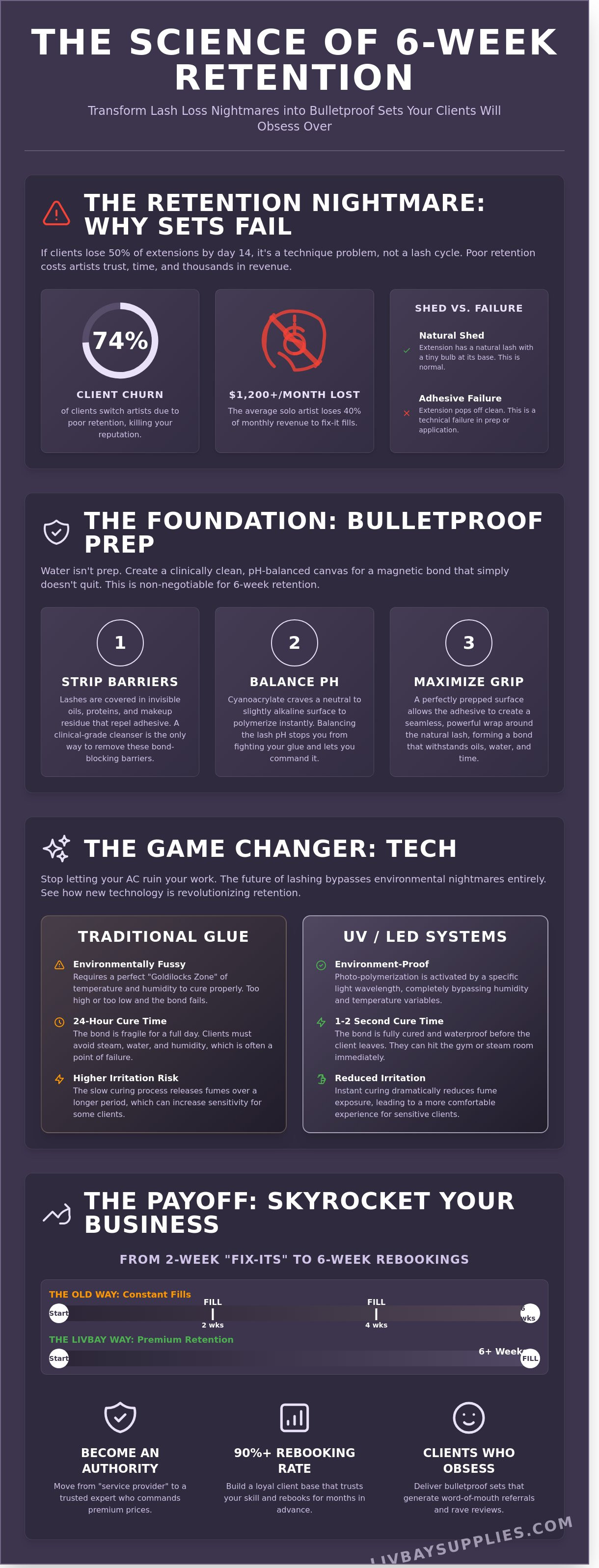
Let's get real for a second. Nothing kills your professional vibe faster than a "lash bestie" sliding into your DMs three days after a service because her fans are raining down like confetti. It is a total nightmare. It's a blow to your confidence and a massive hit to your bank account. If your sets are only surviving 14 days, you are essentially running a charity, not a business. You are losing 40% of your potential monthly revenue to "fix-it" appointments and discounted fills. That is roughly $1,200 a month left on the table for the average solo artist.
Mastering your craft means understanding what eyelash extensions are and how they actually live on a human eye. Lash retention is the delicate balance between the lifespan of your adhesive bond and the natural 60 to 90 day growth cycle. You have to know the difference between a technical fail and a biological process. If an extension pops off clean, your application was trash. If it's still attached to a shed natural lash, you're golden. These lash retention tips are the difference between being a hobbyist and a high-end lash boss who commands $200+ for a full set.
The Science of the Bond
Cyanoacrylate is the magic ingredient in your glue, but it is incredibly fussy. It doesn't just "dry" like nail polish. It reacts to the humidity in your room to create a permanent link. Polymerization is the process of adhesive hardening. This chemical reaction happens fast, but "dry" is not the same as "cured." While a set might feel tack-free in 30 seconds, it takes a full 24 hours for the bond to reach its peak structural integrity. If your client hits the steam room two hours after her appointment, that bond becomes brittle and fails instantly.
Natural Shedding vs. Adhesive Failure
You need to be a lash detective. When a client complains about fallout, look at the base of the extension. If you see a tiny, bulbous root attached to the extension, that's a natural shed. The average human loses 21 lashes per week per eye. That's 3 lashes every single day. You must educate your clients on the three stages of lash growth: Anagen (growth), Catagen (transition), and Telogen (resting/shedding). If they see 15 lashes on their pillow over five days, that is 100% normal biology.
Setting expectations from day one is your biggest power move. If you don't explain the 3-stage growth cycle during the consultation, they will blame your technique for their body's natural processes. Use these lash retention tips to build a foundation of trust. When you can show a client exactly why their lashes are shedding, you move from being a "service provider" to an industry authority. Stop guessing and start obsessed-level tracking of your room's temperature and humidity. Your reputation depends on it.
The emotional cost of bad retention is heavier than the financial one. Losing a client's trust because their $150 investment fell off in a week is a vibe killer that spreads fast through word-of-mouth. In a 2023 industry survey, 74% of clients cited "poor retention" as the primary reason they switched lash artists. Don't let that be your story. Level up your prep, respect the science of the bond, and watch your rebooking rate skyrocket to 90% or higher.
The LivBay Prep Protocol: Squeaky Clean for Maximum Grip
Stop thinking that a quick splash of water counts as prep. If you want sets that stay locked for weeks, you have to treat the natural lash like a high-end canvas. This is precisely why the LivBay Prep Protocol, developed by **LivBay Lash Supplies**, is non-negotiable. Water is the enemy of a true bond because it does absolutely nothing to break down the biological barriers standing between your adhesive and the lash cuticle. We are talking about oils, proteins, and leftover glam that act like a slick slide for your extensions. Without a clinical level of clean, your fans will slide off before the client even hits the parking lot.
Chemistry is the secret sauce behind every "how did she do that" retention post you see on Instagram. Your adhesive is looking for a specific pH balance to create that iconic magnetic bond. Natural lashes are typically slightly acidic, but most adhesives crave a more neutral to slightly alkaline surface to polymerize instantly. When you master the pH, you stop fighting your glue and start commanding it. This level of eyelash extension safety and precision is what separates the kitchen table hobbyists from the six-figure lash bosses.
Oily clients are the ultimate test of your skills. Our 2023 salon data showed that clients with overactive sebaceous glands experience a 40% faster shed rate when standard prep is used. You can't just wish the oil away. You need to strip it without damaging the hair. This means using products designed to lift the "invisible barrier" of dead skin cells and sebum that accumulate at the base of the lash line. If you aren't prepping for the specific skin type sitting in your chair, you are just guessing at your results.
Step 1: The Deep Cleanse
Ditch the makeup wipes and grab a professional Lash Cleanser Foam. You need a formula that's powerful enough to dissolve stubborn waterproof liners but gentle enough not to irritate the eyes. For your heavy makeup wearers, the "Double Cleanse" is non-negotiable. The first wash removes the surface debris, while the second wash actually penetrates the lash scales. Use a soft, dense brush to work the foam into the roots using circular motions for at least 60 seconds. Rinsing is just as vital. Any leftover soap residue will kill your retention instantly, so flood those lashes with distilled water until every bubble is gone. Using high-quality products from LivBay Lash Supplies ensures your cleanser doesn't leave a film behind.
Step 2: Priming and Prep
Priming is a strategic move, not a default step. If your client has ultra-dry or brittle lashes, skipping the primer might actually save their set from popping off. However, for most, a primer is the key to opening the lash cuticle for a better grip. Use the "Banana Peel" test to check your work. If an extension peels off the natural lash smoothly like a fruit skin, your bond is weak and your prep failed. You want that extension to feel like it's part of the natural lash. Finish by ensuring the lashes are 100% dry. Even a microscopic amount of moisture can cause shock polymerization, turning your glue white and brittle. These lash retention tips only work if you have the patience to wait for the dry. Use a handheld fan for a full 30 seconds before you even think about picking up your tweezers.
Traditional Glue vs. UV Lash Systems: The 2026 Game-Changer
Retention isn't just a goal. It's the backbone of your entire business. If your sets are popping off after a week, your clients aren't coming back. You're not just selling lashes; you're selling a lifestyle of effortless beauty. To master this, you have to understand the chemistry in your hand. We're moving past the dark ages of glue drama. The industry is shifting toward high-tech solutions that put the power back in your hands. Stop letting your environment dictate your success. It's time to level up.
The Problem with Traditional Adhesives
Traditional lash glues are high-maintenance. They're obsessed with your room's vibe. Most cyanoacrylate adhesives demand a strict humidity range, usually between 45% and 55%, to function correctly. If your salon hits 65% humidity on a rainy day, your glue cures too fast. This leads to poor attachment. If it drops to 30% in the winter, you're stuck waiting for lashes to dry while they lean and slide. This happens because moisture is the literal trigger for the bond. Scientists have studied how lash adhesive cures through polymerization, and it's a delicate balance. One of the most important lash retention tips is to avoid "shock curing." This occurs when you use too much moisture too fast. It creates a white, frosted look and a brittle bond that snaps like a dry twig. Freshness is another killer. A bottle of glue opened for more than 30 days is basically trash. Its bonding power can drop by 40% as the chemicals degrade, leaving you with sets that fail before the first fill.
The UV Revolution
Enter the UV lash system. This is the 2026 standard for artists who are tired of the humidity struggle. UV systems use a specific L.E.D. wavelength to cure a photo-reactive adhesive instantly. You aren't waiting for the air to do the heavy lifting anymore. You're in total control of the dry time. This tech completely eliminates the old "24-hour no water" rule. Your clients can go straight from your lash bed to a pool party or a steam room. There's no waiting period because the bond is 100% polymerized the second the light hits it. This is also a massive win for sensitive clients. Traditional glues release fumes as they slow-cure over 24 hours. UV systems stop those fumes instantly, reducing redness and irritation for 90% of reactive clients.
UV adhesive cures in seconds, regardless of room humidity.
When we compare viscosity and strength, the differences are wild. Traditional glues are often thin and watery. They require a perfect dip every single time. Magnetic systems are even worse. They use iron-oxide liners that have zero structural integrity for professional extensions. UV adhesives have a slightly thicker, more controlled viscosity. They grip the natural lash like a magnet without the mess. You get an unbreakable bond that holds until the natural lash naturally sheds. Switching to a UV system can increase your application speed by 30% because you aren't fighting stickies or slow-drying fans. It's the ultimate hack for any boss babe looking to dominate the market.
Mastering Your Environment (Before It Masters You)
Listen up, lash besties. You can have the most expensive tweezers and the baddest mapping skills in the industry, but if your room environment is trash, your retention will be too. Your adhesive is a sensitive little diva. It reacts to every single molecule in the air. To hit that legendary six week retention goal, you have to live in the Goldilocks Zone. We are talking 45% to 60% humidity. This is the sweet spot where the magic happens. If your levels drop below 40%, your glue stays wet for too long. Lashes will lean, slide, and drive you insane. If it spikes above 65%, you get shock curing. That is when the glue cures too fast and turns white or brittle. It looks amateur and it won't last a week.
Your AC and heater are secretly plotting against your success. They are the ultimate retention killers. A standard office heater can suck 15% of the moisture out of your room in under 12 minutes. You need a hygrometer sitting right next to your lash tile. Not across the room on a shelf. Not on the wall by the door. It needs to be exactly where you are working. Check those numbers every 20 minutes. Things change fast when the sun hits the window or the building's climate control kicks in. If you are not tracking your data in real time, you are just guessing. Guessing is for hobbyists. Professionals track everything to ensure their lash retention tips actually work for their clients.
Isolation mastery is the bridge between a good set and a masterpiece. Stickies are the enemy of healthy lashes. When two natural lashes bond together, it causes premature shedding and permanent follicle damage. It hurts the client and ruins your reputation. Take the extra 5 seconds to check every single lash before they leave your chair. Use your mirror to look for those tiny "hitchhikers" hiding in the inner corners. Perfect isolation means every natural lash can grow at its own pace without being held back by its neighbor.
Controlling the Lash Room
Stop playing games with your air quality. If your hygrometer shows 30% humidity, get a high-powered humidifier pumping immediately. If you are working in a swampy climate and hitting 70%, a dehumidifier is your new best friend. Temperature is the other half of the battle. Keep your space between 68 and 72 degrees Fahrenheit. When your room gets too hot, glue viscosity turns into water. It becomes impossible to control. Use a carbon filter air purifier to pull adhesive fumes away from the workspace. This keeps the air "clean" and prevents the glue from reacting to outside pollutants before it hits the lash.
Application Technique Tweaks
The "Seamless Wrap" is a total game-changer for your volume sets. You are not just placing a fan on top of the lash. You are wrapping the base around the natural lash like a tight hug. This creates a 360-degree bond that is basically bulletproof. Aim for a solid 2mm base attachment every single time. This provides the maximum surface area for the adhesive to grip. Whatever you do, stop swiping the glue. Swiping is an old-school habit that needs to die. It polymerizes the adhesive before it even touches the natural lash. Dip, lift, and place. That is the only way to slay the retention game.
Stop letting your environment ruin your hard work and start dominating your workspace like the boss you are.
Grab the Pro Tools You Need to Slay Your SetsThe Aftercare Talk: Training Your Clients to Win
You can be a total lash god in the studio, but if your client walks out and treats their extensions like an afterthought, your work is doomed. Retention is a 50/50 partnership. You provide the flawless application, and they provide the daily maintenance. If they aren't holding up their end of the bargain, your reputation takes the hit. You must frame aftercare as the ultimate insurance policy for their investment. When clients follow proper lash retention tips, they save money on frequent fills and keep their natural lashes healthy.
The "No Oil" rule is your first line of defense. Oil is the silent killer of cyanoacrylate bonds. It doesn't just "loosen" the glue; it creates a chemical barrier that makes the extension slide right off the natural hair. Educate your clients on the hidden dangers in their vanity. About 85 percent of drugstore makeup removers contains glycol or oils that compromise the bond. If they're using a biphase remover or a heavy night cream, they're literally melting your hard work away while they sleep. Tell them to check every label or, better yet, only use what you provide.
Daily lash baths are the second non-negotiable. Some clients are terrified to touch their lashes because they think water makes them fall out. It's the exact opposite. Sebum, dead skin, and sweat build up at the base of the lash line. This "lash crust" leads to inflammation and poor retention. Selling aftercare kits isn't just a retail play; it's a professional service. When you hand them a kit, you're giving them the power to make that set last 4 weeks instead of 10 days. It positions you as an expert who cares about their results, not just their cash.
When recommending products, consider options that align with your clients' values. For instance, if they prioritize vegan and cruelty-free formulas, the botanical skin and hair care line from Vixxar offers science-backed solutions that support lash health without compromising the bond.
Similarly, being aware of all aspects of a client's lifestyle helps build rapport. For instance, for clients who choose to vape, being able to point them towards a reputable online store can be a helpful touch; you could suggest they visit Vape Center for a wide range of products.
The Non-Negotiable Rules
Sleeping habits can wreck a set in a single night. Side-sleepers usually show up to fills with 30 percent less volume on one eye. Recommend silk pillowcases. They reduce friction and prevent the lashes from snagging during the night. Brushing is another hurdle. Clients love to over-brush, which can actually pull extensions out prematurely. Teach them to brush from the mid-shaft to the tips only. Most importantly, tell them to stop picking. A single "tug" can rip out a natural lash in the anagen phase, causing permanent follicle damage over time.
Level Up Your Career with LivBay
At the end of the day, your technique is what sets you apart from the "budget" techs down the street. High-quality adhesive is a must, but it can't fix poor isolation or a bad wrap. You have to be obsessed with the craft. Investing in an Online Lash Extension Course is the fastest way to master these lash retention tips and refine your mechanical skills. When you understand the science behind the bond, you become unstoppable. You aren't just applying lashes; you're building a brand based on excellence and longevity. Ready to dominate the industry? Shop LivBay Supplies now!
Stop Chasing Fills and Start Owning the 6-Week Standard
Stop settling for mediocre sets that shed before the weekend hits. You now have the blueprint for 6-week retention. Mastering the LivBay Prep Protocol and switching to UV technology means you're no longer a slave to 50% humidity or finicky room temps. These lash retention tips aren't just suggestions; they're the high-performance requirements for any artist who wants to dominate the market. Mike and Shauna Jones founded this brand to disrupt the status quo, and today, our UV systems are the secret weapon used by the top 1% of lash artists globally.
Join the thousands of Boss Babe lash besties who've ditched the retention nightmare for good. Whether you're upgrading your adhesive or overhauling your entire setup, the tools you use define your reputation. It's time to work smarter and lash faster. Your clients deserve that elite grip, and your business deserves that "always booked" status. Don't let a bad bond kill your vibe when the solution is right here.
Upgrade your retention with LivBay UV Systems and Pro Supplies!
You've got the skills, now get the gear to match your hustle. We're obsessed with your success and can't wait to see you win!
Frequently Asked Questions
How long should lash extensions realistically last?
A professional full set should realistically last 4 to 6 weeks depending on the natural growth cycle. You'll see about 20% to 30% of extensions shed by the 14 day mark as natural lashes fall out. To keep that LivBay look snatched, tell your clients to book fills every 2 to 3 weeks. Anything longer than 21 days is pushing it if they want max volume.
Does humidity really affect my lash glue that much?
Humidity is the ultimate deal-breaker for your adhesive because it controls how fast your cyanoacrylate cures. If your room hits 70% humidity, your glue will shock cure in under 0.5 seconds, leading to pop-offs and terrible retention. Keep your space between 45% and 60% humidity to ensure the bond is bulletproof. These lash retention tips will save you from constant redo sessions.
Can I use a UV lash system if I am a beginner?
Beginners can absolutely use a UV system to bypass traditional curing struggles and temperature drama. This tech cures the bond in exactly 1 second regardless of your room's environment. It's a total game-changer for new artists who haven't mastered humidity control yet. You'll spend 20% less time worrying about stickies and more time perfecting your mapping and isolation.
Why do my clients lashes fall out on one eye faster than the other?
It's almost always because your client is a side-sleeper who crushes their extensions into the pillow. Data shows 90% of lopsided fallout happens on the side the client favors at night. Another factor is your application speed. If you're a right-handed artist, you might apply glue 15% slower on the left eye, causing the adhesive to dry before it hits the natural lash.
Is it okay for my clients to get their lashes wet immediately after the set?
You can let them get wet immediately if you finish the set with a professional bonder. Traditional rules said wait 24 hours, but modern bonders cure the glue in under 3 minutes. This eliminates the no water rule entirely. Just make sure you're using a product like Mega Bond to seal those fumes and lock in the attachment instantly for your client.
What is the best lash glue for high humidity environments?
Look for a slow-drying adhesive with a 2 to 3 second cure time when your room hits 65% humidity. High moisture speeds up the chemical reaction, so a fast glue will dry before you even touch the lash. Using a high-humidity specific glue ensures you get a seamless wrap every time. These lash retention tips are essential for artists working in tropical or coastal climates.
How often should I be changing my glue drop during a set?
You need to refresh your glue drop every 15 to 20 minutes to keep the viscosity perfect. After 20 minutes, the outer edges start to polymerize, making the glue goopy and weak. If you're working a 2 hour full set, you should go through at least 6 fresh drops. It's a small price to pay for a bond that actually lasts until the next fill.
Do I really need to use a lash primer for every client?
You don't need primer for every single set. It's actually a mistake to use it on the 30% of clients who have naturally dry lashes because it can over-dry them and cause brittle retention. Save the primer for your oily girls or those with heavy makeup residue. A simple saline prep or lash bath is often enough to get the job done perfectly.