


What if the secret to your most expensive-looking lash set isn't more lashes, but less black? Stop defaulting to jet black just because it’s the industry standard. Your obsession with the darkest pigment might be the very thing holding your artistry back. Choosing between dark brown vs black lash extensions isn't just about color; it’s about structural manipulation. You've seen it happen. A fair-skinned client wants volume, you give them midnight black, and suddenly they look like they’re wearing plastic. It’s harsh. It’s dated. It’s definitely not the elite vibe your brand deserves.
We know the struggle of trying to explain why natural doesn't mean invisible or why those chocolate tones aren't looking dense enough. You’re ready to move past the basic lash maps and start designing sets that actually compliment a client's unique features. This guide will teach you to master color theory so you can deliver customized, high-end sets that keep your clients obsessed. We’re diving into the technical secrets of density, eye brightness, and the exact scripts to use when selling the luxury of brown lashes to your most skeptical, drama-loving clients.
Key Takeaways
- Learn to use lash color as a structural tool to manipulate perceived density and create high-end, bespoke sets.
- Master the technical science of light absorption to strategically choose between dark brown vs black lash extensions for every diameter.
- Use the Fitzpatrick Scale to determine the perfect contrast ratio that makes your client’s specific eye color pop.
- Discover pro-level mapping secrets like the 'Ombre' technique and using black spikes to add dimension to brown sets.
- Level up your artistry with high-pigment trays that deliver a rich, expensive finish without any of that "fake" plastic shine.
Beyond the Basics: Why Lash Color is Your New Secret Weapon
The era of "one tray fits all" is dead. If you're still slapping jet black lashes on every human who walks through your door, you’re leaving money on the table. It’s 2026. High-end artistry isn't about how many fans you can stack; it’s about how you manipulate light and shadow. The debate of dark brown vs black lash extensions has evolved from a simple color choice into a structural strategy.
Modern Eyelash extensions have come a long way from the stiff, plastic strips of the past. Today, we’re using color to mimic the complexity of natural hair. The "Clean Girl" and "Quiet Luxury" trends of 2026 have driven a massive surge in demand for softer tones. Clients want to look expensive, not obvious. They want the "I woke up like this" vibe, but with the added density only a pro can provide.
Enter "Visual Weight." This is the secret sauce for elite mapping. Black lashes have a high visual weight. They demand attention. They create a sharp, graphic line. Brown lashes? They offer a lower visual weight. Brown lashes diffuse light. This technique allows you to build massive density without the set looking heavy or "fake." You can pack in the fans while maintaining a sophisticated, wearable texture.
The Evolution of the Lash Palette
For a decade, black was the industry default because it was the only way to get "pop." But the game changed. Social media filters now prioritize soft, ethereal glows. This shifted client expectations. Dark brown has emerged as the "new neutral." It provides the depth of a dark lash with the sophistication of a luxury finish. It’s why our Dark Brown trays are a staple for the modern lash extension training graduate. You aren't just learning to apply; you're learning to curate.
Why Your Clients Are Asking for 'Natural' (But Still Want the Pop)
"Natural" is the most misunderstood word in the lash room. When a client says they want natural, they usually mean they want to avoid the dreaded "caterpillar" look. They’re terrified of that harsh, blocky aesthetic that screams budget salon. By positioning dark brown vs black lash extensions as a bespoke choice, you’re selling a premium service. You can even mix them for a full set eyelash extensions that looks effortless yet intentional. You’re telling them, "I’m not just a tech; I’m a color theorist." This builds trust. It justifies your higher rates. It keeps them coming back for that "Quiet Luxury" vibe that only you can provide.
Dark Brown vs. Black Lash Extensions: The Technical Breakdown
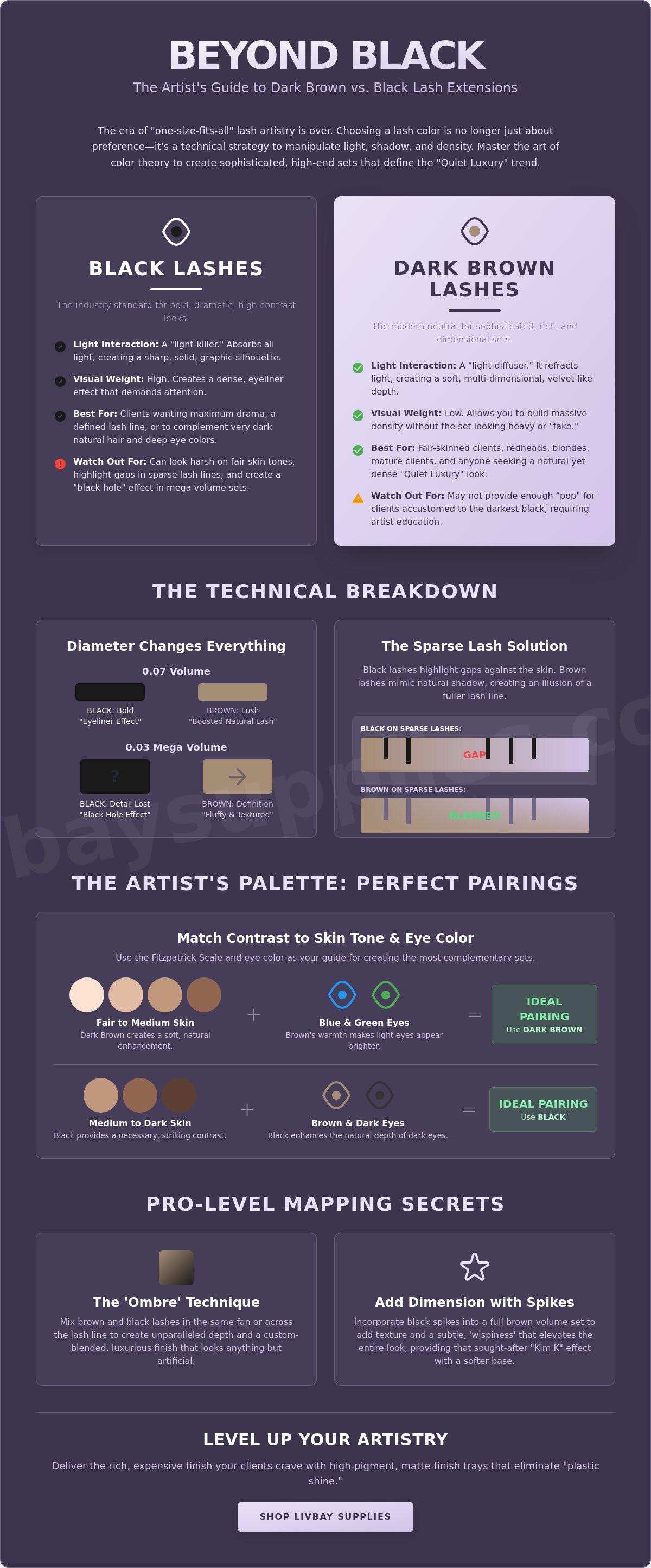
Black is a light-killer. It absorbs every photon that hits it, creating that sharp, high-contrast silhouette we all know. Brown is different. It’s a light-diffuser. When you’re choosing between dark brown vs black lash extensions, you’re deciding how you want the sun to play with your work. Black lashes create a solid, graphic weight. Brown lashes allow for refraction, giving the set a multidimensional, velvet-like depth that looks expensive because it is complex.
The diameter of the lash changes the game entirely. A 0.07 black lash looks like a bold stroke of eyeliner. But a 0.07 dark brown lash? It looks like a healthy, lush natural lash boosted to its maximum potential. If you’re working with 0.03 mega volume fans, black can sometimes turn into a "black hole" effect where all detail is lost. Using dark brown in those high-density sets keeps the individual fan geometry visible. You get the fluff without the flat, heavy look of a solid black block.
Then there’s the "Gappy" factor. We’ve all had clients with sparse natural lashes. When you use jet black on a sparse lash line, the contrast against the skin actually highlights the gaps. It’s a literal spotlight on the areas where lashes are missing. Dark brown mimics the natural shadow of the lash line. It fills those spaces with a soft, hazy density that tricks the eye into seeing a fuller, more uniform fringe. It’s a technical hack for your most challenging canvases.
Fiber Science: Reflectivity and Depth
Stop settling for plastic shine. Cheap black lashes often have a blue or purple undertone that screams "synthetic" the second your client steps into the sun. Premium dark brown fibers are engineered with a matte finish. They absorb just enough light to show off their rich, chocolatey pigment without that tacky, reflective glare. This matte texture also helps hide the attachment zone. Following strict eyelash extension safety protocols means choosing professional-grade fibers that won't irritate the eye or look like doll hair after three days of wear.
Interaction with Adhesive Systems
Your adhesive choice can make or break a brown set. Using standard carbon black adhesive on dark brown lashes can create a tiny "ink spot" at the base of every extension. It ruins the seamless blend. This is where clear UV lash systems change your entire workflow. Clear adhesive is the gold standard for brown lash retention because it eliminates the visible bond line while providing a crystal-clear finish that lets the brown pigment shine from root to tip. UV curing ensures that bond stays locked, keeping your bespoke color matching looking fresh until the fill. If you haven't tried mixing tones with a clear bond, you’re missing out on the cleanest transitions in the industry.
The Artist’s Palette: Matching Color to Eye Tone and Complexion
Stop guessing. Elite lashing isn't about vibes; it’s about science. When you’re staring down the dark brown vs black lash extensions dilemma, you need a framework. That framework is the Fitzpatrick Scale. By identifying your client’s skin type, you can calculate the "Contrast Ratio" before you even pick up your tweezers. A Fitzpatrick Type I client with jet black lashes creates a high-contrast, editorial look. It’s bold. It’s loud. But for the client wanting "Quiet Luxury," that same black set can look like a costume. Dark brown provides a mid-contrast finish that feels integrated rather than applied.
Skin Tone and Undertones
Undertones are the silent killers of a good set. If your client has cool, pink undertones, a warm, reddish-brown lash will look "off." You need a neutral, deep cocoa. Conversely, warm, golden skin tones thrive with rich, chocolatey hues. Then there’s the "Shadow Effect." Heavy black pigment can actually cast a physical shadow on the under-eye area. For clients already struggling with dark circles, black extensions can make them look tired. Switching to dark brown softens the perimeter, reflecting light back onto the face instead of absorbing it. It’s a subtle shift that changes the entire facial dynamic.
Eye Color Enhancement Theory
We’re using color theory to make eyes pop, not just lashes. Dark brown is a game-changer for blue and green eyes. Because brown contains warm undertones, it acts as a complementary shade that makes cool-toned irises look more vibrant. It’s the difference between "nice lashes" and "your eyes look incredible." For brown-eyed beauties, black is often the winner. It creates a "built-in eyeliner" effect that deepens the gaze and provides a sharp, graphic frame for the iris. It’s about creating a "Halo Effect" where the lashes serve the eye, not the other way around.
Don't forget the "fountain of youth" factor. For mature clients, skin often becomes thinner and more translucent. Jet black can look heavy, dragging the eye downward and highlighting fine lines. Dark brown provides the definition they crave without the visual weight. It’s also the only way to handle the "Blonde Dilemma." When a natural blonde has translucent lashes, a black extension creates a harsh, visible "dotted line" at the attachment zone. Brown blends the transition, making the set look like it actually grew there. If you want to dive deeper into these advanced mapping strategies, our Online Lash Extension Course covers the full spectrum of color theory. Mastering these nuances is how you stop being a technician and start being an artist.
Mapping for Mastery: How to Mix Tones for Dimension
Stop playing it safe. The most sought-after artists in 2026 aren't just choosing one color; they’re blending them to create depth that a single-tone set can't touch. When you master the transition between dark brown vs black lash extensions within a single map, you unlock a level of customization that keeps your chair full. You’re not just a lash tech anymore. You’re a designer. Mixing tones allows you to fix common structural issues while giving your clients that "how did she do that?" finish.
Try the Ombre Technique for clients who want drama without the "fake" weight. Place black lashes at the base of the natural lash to create a dense, eyeliner-effect root. Then, transition to dark brown for the tips. This creates a soft, airy perimeter that mimics the way natural hair lightens toward the ends. It’s the ultimate hack for a full set eyelash extensions that looks both thick and ethereal. If you have a client addicted to black but curious about brown, don't do a full removal. Use their next fill to strategically intersperse brown fans, softening the look over time without the drama of a total reset.
The 70/30 Rule for Multi-Tonal Sets
Balance is everything. If you mix colors randomly, the set looks messy and unfinished. Stick to the 70/30 rule. Use one color as your primary foundation (70%) and the other as your dimensional accent (30%). To pull this off, you need high-quality lash supplies that offer consistent curls across both pigments. There is nothing worse than a C-curl black lash that doesn't match a C-curl brown lash. When your diameters and curls are identical, the colors blend seamlessly, creating dimension instead of distraction.
Texturizing with Color
Use color to manipulate the eye shape. Many clients have irregular growth patterns or "crossover" lashes that make mapping a nightmare. Dark brown is your eraser. Use it to soften the inner corners where black might look too heavy or highlight gaps. For a textured, wispy look, build your main body in dark brown and use jet black "spikes" to create high-contrast peaks. This makes the texture pop against the softer brown background. Color Mapping is the next frontier of bespoke lash design. It’s how you build a brand that budget salons can't replicate. Ready to start blending? Grab our pro-grade Brown and Black trays and start experimenting with these multi-tonal maps today.
Level Up Your Artistry with LivBay Brown and Black Trays
Your artistry deserves more than basic. If you're ready to dominate the market in 2026, you need fibers that work as hard as you do. The LivBay difference is simple: we provide deep, soul-satisfying pigment without that tacky, "fake" shine that ruins a high-end set. When you’re weighing the choice of dark brown vs black lash extensions, the quality of the tray is the only thing that matters. Our Dark Brown collection is a non-negotiable staple for every lash extension training graduate who wants to stand out from the budget-salon crowd. It’s about building a lifestyle of success, not just doing a job.
Whether you're rocking our cutting-edge UV systems or sticking with the best eyelash glue in the game, our fibers are engineered for maximum bond. They don't just sit there. They lock in. This reliability empowers every Boss Babe to charge premium prices. You aren't just selling lashes; you're selling a bespoke, color-matched experience that your competitors can't touch. You’re the expert. Act like it.
Product Spotlight: The LivBay Dark Brown Collection
We give you total creative freedom. From various diameters to the crispest curls, our trays are a tech's favorite for a reason. They fan like a dream. Whether you’re pinching or fanning on the strip, the fibers respond with zero resistance. Joining the LivBay community means you're part of an elite group of rule-breakers. We don't follow trends; we set them. Our dark brown fibers maintain their curl and rich pigment until the very last day of the set, ensuring your reputation remains flawless.
Closing the Deal with Your Client
Don't just tell them; show them. During your consultation, present the dark brown vs black lash extensions options side-by-side. Use "Trial Fans." Place one brown fan and one black fan on their outer corner to let them see the contrast against their own skin. Once they see that rich, chocolatey depth, the upsell to a custom color set is effortless. It’s about the "wow" factor. Stop playing small. It’s time to own your expertise and give your clients the high-end sets they’re craving. Shop the LivBay Brown & Black Collections Now and start building your empire.
Master the Hue, Build Your Empire
You’ve got the technical breakdown and the color theory secrets. Now it’s time to execute. Choosing between dark brown vs black lash extensions isn't just a simple preference; it’s your new signature. Use that proprietary matte fiber technology to build sets that look like high-end velvet. Whether you’re layering for a sun-kissed effect or using UV-compatible fibers for insane retention, you’re now equipped to move beyond basic lashing. You have the technical mastery to manipulate density and eye brightness like a true industry insider.
Join the 50,000+ lash artists worldwide who trust our fibers to deliver that expensive, non-reflective finish every single time. Our trays are built for the trend-setting rebel who refuses to follow outdated industry rules. Don't just apply lashes. Design bespoke looks that command premium prices and leave your clients obsessed with your craft. The industry is moving fast. Don't get left behind with a one-size-fits-all mindset. Go out there and dominate your market. We can't wait to see what you create.
Ready to master the art of color? Shop our premium lash trays today!
Frequently Asked Questions
Do brown lash extensions look as full as black ones?
Brown lashes can actually look fuller than black when you’re working with sparse natural lashes. Because brown pigment diffuses light rather than absorbing it, it creates a soft, hazy density that fills gaps without the harsh contrast of black. It gives you a lush, velvet-like finish that looks expensive and voluminous without looking like a solid plastic block.
Can I mix brown and black lashes in the same set?
Mixing is the ultimate pro move for 2026. Use the 70/30 rule to keep the look intentional. Place black lashes along the bottom layer to create a dense, eyeliner-effect root, then use dark brown on the top layers for a textured, sun-kissed perimeter. This layering adds a level of dimension that a single-color set simply cannot touch.
Which eye colors look best with dark brown lash extensions?
Blue, green, and hazel eyes are the biggest winners with brown tones. The warm, chocolatey undertones in the brown fibers act as a complementary shade to cool-toned irises, making them look significantly more vibrant. It’s the difference between the lashes being the focus and the client’s actual eyes being the star of the show.
Are brown lashes more expensive for the client?
You should absolutely position brown lashes as a premium, bespoke service. You aren't just doing a standard set; you're applying custom color theory to enhance their specific features. High-end artists often charge an upgrade fee for this level of customization. It’s an easy way to increase your revenue while delivering a more exclusive, tailored result.
Do brown lashes have the same retention as black lashes?
Retention has nothing to do with the pigment of the fiber and everything to do with your adhesive and prep. When choosing between dark brown vs black lash extensions, your bond strength remains the same. As long as you’re using professional-grade supplies and following a strict prep routine, your brown sets will last just as long as your jet black ones.
What color adhesive should I use with brown lash extensions?
Clear adhesive is the gold standard for any brown set. Using carbon black glue can create tiny, dark "ink spots" at the attachment zone that ruin the seamless transition. Clear UV systems are a game-changer here because they provide a crystal-clear bond that stays invisible, letting the rich cocoa pigment of the lashes shine from root to tip.
How do I convince a client to try brown lashes if they always get black?
Show, don't tell. During the consultation, place one dark brown fan and one black fan on their outer corner using a tiny bit of adhesive. Once they see how the brown tone softens their features and makes their eye color pop in the mirror, the fear of "natural" looking "invisible" usually disappears. It’s the most effective upsell in your toolkit.
Is there a difference in maintenance between black and brown lashes?
The maintenance routine is identical. Your clients still need to use a professional lash cleanser foam daily to remove oils and debris. Whether they choose dark brown vs black lash extensions, the durability of the set depends on their aftercare. The only difference is the aesthetic vibe, so their daily cleaning and brushing routine stays exactly the same.