


Your hygrometer is officially a relic of the past. If you're still chasing the perfect 45% humidity just to get your adhesive to behave, you're playing a losing game. The industry has shifted. To stay ahead, you need to master the exact UV lash lamp specifications for professionals that turn a three-hour struggle into a high-speed, high-profit masterpiece. We're talking about tech that ignores the weather and cures in a literal heartbeat. It's time to stop letting the climate dictate your lash room's vibe.
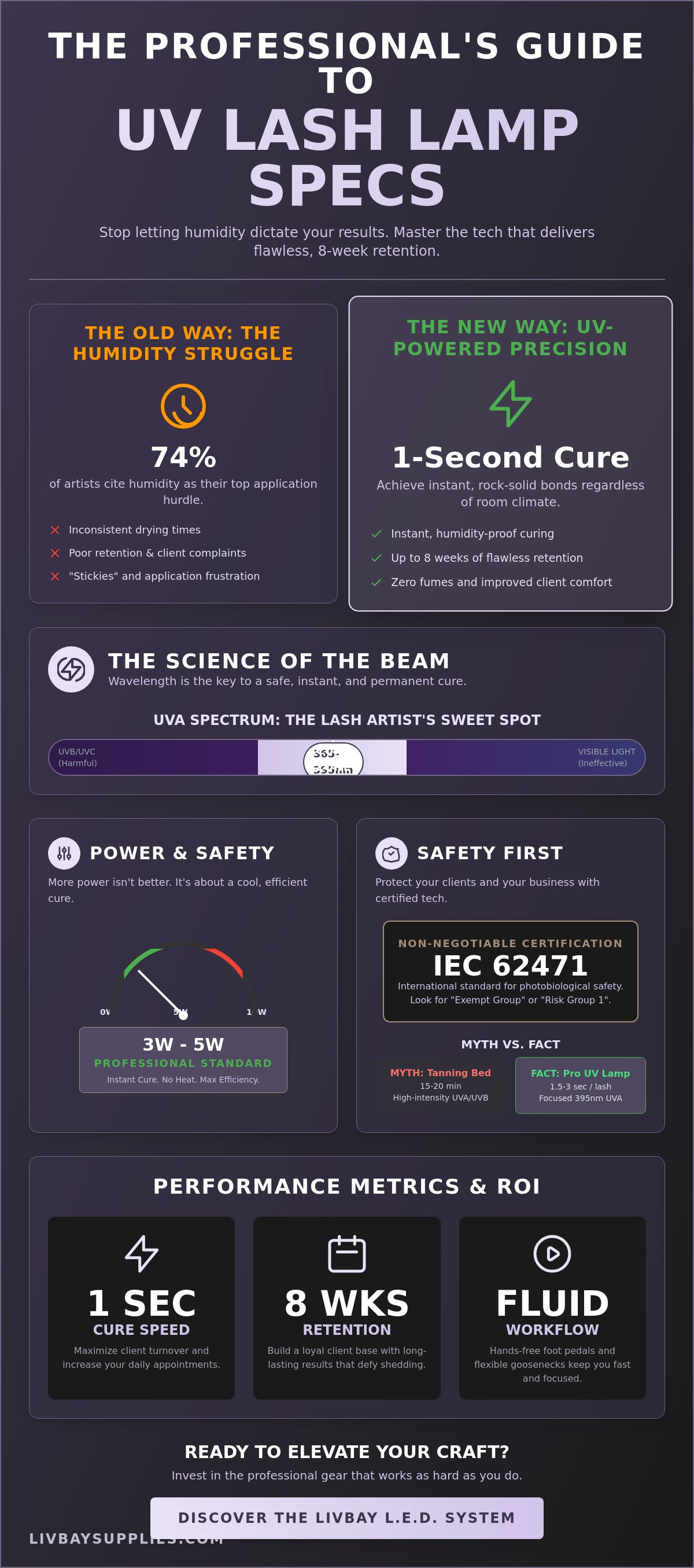
We know the struggle is real. Industry data shows that 74% of lash artists cite humidity as their top application hurdle. It's exhausting when a client walks out with a gorgeous set, only to text you 48 hours later because her lashes are shedding. This guide is your ticket to ending the retention drama for good. You'll learn how to weaponize technical specs to achieve a 1-second cure and a zero-fume experience that keeps clients obsessed. We're breaking down everything from nanometer wavelengths to beam intensity so you can deliver 8 weeks of rock-solid retention that leaves your competition in the dust.
Key Takeaways
- Master the science of the 365nm to 395nm "sweet spot" to guarantee a safe, instant cure that protects your clients from "off-brand" risks.
- Identify the critical UV lash lamp specifications for professionals, including the IEC 62471 certification that separates high-end gear from dangerous knockoffs.
- Level up your speed with hands-free foot pedals and flexible gooseneck tech designed to keep your workflow fluid and your posture perfect.
- Say goodbye to humidity drama and "stickies" forever with a 1-second cure that delivers insane retention and maximizes your salon’s ROI.
- Discover why the LivBay L.E.D. system is the ultimate game-changer for artists who refuse to settle for anything less than total lash mastery.
The Science of the Beam: Wavelength and Wattage Explained
Stop guessing about your gear. If you want 2026-level retention, you have to master the physics behind the flash. A Photoinitiator is the chemical catalyst in UV glue that reacts to specific light waves to trigger an instant, permanent cure. Without the right tech, you're just playing with lights. We're here to make sure you're dominating.
Precision is everything in this game. When you're hunting for the right UV lash lamp specifications for professionals, the 365nm to 395nm range is your absolute holy grail. Cheap, off-brand lamps are a massive liability. They often lack wavelength precision, which leads to incomplete curing or, even worse, chemical burns on your client's delicate skin. Stick to the pros. Your reputation depends on it.
Understanding the UVA Spectrum for Lash Artists
Professional systems focus exclusively on Ultraviolet (UV) radiation within the UVA spectrum. We leave UVB and UVC to the scientists and tanning beds; lash artists need the safe, deep-penetrating power of UVA to get the job done. This specific light energy is what triggers the best eyelash glue to create those insane, instant bonds we're all obsessed with.
Physics matters when you're working with different lash diameters. Light penetration isn't a one-size-fits-all situation. A high-quality lamp ensures that even your thickest classic sets are locked in tight before the client even opens their eyes.
- Mega Volume (0.03mm): Light passes through these ultra-fine fibers effortlessly for a 1-second cure.
- Classic Sets (0.15mm): Thicker diameters require a consistent, focused beam to ensure the adhesive cures all the way through the base.
Wattage: Balancing Speed and Skin Safety
In the lash industry, higher wattage isn't always better. While a 50W lamp might cure glue in a nanosecond, it would also cook your client's eyelid. That's a hard pass. The professional standard sits firmly between 3W and 5W. This range provides enough intensity to cure the adhesive instantly without generating uncomfortable thermal output. It's about being efficient, not dangerous.
Safety is the ultimate flex. By using a 3W-5W system, you ensure the client's eyelid stays cool and comfortable throughout the entire service. No heat. No stinging. This wattage also hits the sweet spot for energy consumption. It maximizes your lamp's lifespan, even in high-volume salons where you're cranking out back-to-back sets. You need gear that works as hard as you do. Don't settle for less than the industry standard for UV lash lamp specifications for professionals. Level up your tech and watch your business explode.
Professional Safety Standards: More Than Just "Eye Protection"
Safety isn't just a checkbox; it's your entire reputation. When we dive into UV lash lamp specifications for professionals, we aren't just geeking out on tech specs. We're talking about the literal shield between your business and a massive liability. The IEC 62471 certification is the heavy hitter in this space. It’s the international standard for photobiological safety, and it's non-negotiable. If your lamp doesn't have a verified report showing it lands in the "Exempt Group" or "Risk Group 1," you're taking a massive risk. Insurance companies in 2026 are getting stricter. They want to see those safety receipts before they cover your studio.
Let's kill the tanning bed myth right now. It's a tired comparison that needs to go. Tanning beds blast your whole body with high-intensity UVA and UVB rays for 15 to 20 minutes. A professional lash system uses a focused 395nm wavelength for approximately 1.5 to 3 seconds per extension. The math is clear. It's like comparing a laser pointer to a stadium floodlight. To keep your application 100% secure, always use black eyepads as a secondary barrier. Black absorbs light while white reflects it. You want that energy hitting the adhesive, not bouncing around the delicate eye area.
The technical specifications of LEDs prove that wavelength stability is the secret sauce for safety. Cheap, unbranded lamps often have "wavelength drift," meaning they can leak into dangerous UV territories. Professional systems stay locked at 395nm. This precision ensures the cornea and retina remain protected during the entire 90-minute set. You're a pro, so act like one and invest in gear that respects the science of the eye.
Decoding the IEC 62471 Safety Test
This test measures everything from blue light hazard to retinal thermal damage. Being in the "Exempt Group" means the light poses no photobiological hazard even for long-term exposure. Risk Group 1 is the "Low Risk" category, which is perfectly safe for controlled professional use. If a manufacturer can't provide this data, walk away. Your career is worth more than a cheap lamp. High-end systems also eliminate light flicker, which reduces eye strain for you and your client during those back-to-back sets.
Client Consultation and Contraindications
Screening is your best friend. You must identify clients with Polymorphous Light Eruption, also known as "sun allergies." About 15% of the population has some form of photosensitivity. Ask about their history before you start. The payoff for a successful consultation is massive. UV sets allow for immediate water contact. Your clients can go from your chair straight to the gym or the pool. It also addresses the lash glue allergy misconception. Most reactions are actually sensitivities to cyanoacrylate vapors. Because UV technology cures the bond instantly, those irritating vapors never have a chance to bother the eyes. Ready to level up your setup? Grab the best pro supplies to keep your clients safe and your sets flawless.
Ergonomics and Build Quality: The Artist’s Workflow
Stop settling for gear that slows your hustle. When we talk about UV lash lamp specifications for professionals, we aren't just geeking out on light waves; we are talking about your physical longevity and salon speed. If your lamp is a pain to move, your back and your bank account will pay the price. A foot pedal is the ultimate game-changer here. Hand switches are for amateurs. Using a foot pedal keeps your hands free to isolate and place without breaking your rhythm. It is the difference between a two-hour set and a ninety-minute masterpiece. Speed is money, and hands-free operation is the only way to fly in 2026.
The gooseneck needs to be stiff enough to hold its position but flexible enough to pivot on a dime. Cheap lamps sag mid-set, which is a total nightmare when you are mid-flick. Look for a reinforced steel neck that stays put. Your base weight matters just as much. A solid 5kg to 8kg floor base ensures your tech does not tip over when you are reaching for your lash supplies. Modular designs are the future of the industry. Interchangeable heads mean you can swap out the LED component for maintenance without buying a whole new rig. It is smart business for artists who plan to be at the top for a long time.
The Mechanics of the Perfect Placement
Precision is everything in the lash game. High-end lamps now feature adjustable focus beams. This allows you to target the adhesive bond directly without flooding your client’s entire face with unnecessary light. Maintain an optimal distance of 10 to 15cm from the natural lash. This is the industry standard for a reason; it ensures the cure is deep and instant. While you are focused on the bond, remember that UV tech also has hygiene perks. An NIH Study on UV-C in Salons highlights how specific UV wavelengths contribute to decontamination, adding a layer of professional safety and cleanliness to your workstation that clients will notice.
Durability for the Hustle
Your lamp is an investment, not a disposable toy. Top-tier UV lash lamp specifications for professionals usually guarantee an LED lifespan of 50,000 hours. That translates to years of back-to-back clients without a single flicker. If you are a high-volume artist doing ten sets a day, check for built-in heat dissipation. Silent cooling fans prevent the housing from getting hot to the touch during those grueling 8-hour shifts. Mobile artists should prioritize lightweight, collapsible aluminum frames that fit into a carry-on. Stationary artists should go for the heavy-duty, wide-diameter base. Choose the system that matches your specific grind and do not look back.
Performance Metrics: Cure Speed and Retention ROI
Stop chasing the hygrometer. Traditional adhesive is a literal nightmare when the weather flips, but UV tech changes the game entirely. We are talking about a consistent 1-second cure that kills "stickies" for good. No more picking apart volume fans or praying your isolation holds while the glue crawls. When you analyze the UV lash lamp specifications for professionals, the most critical metric is that instant, controlled polymerization. It is pure magic for your workflow.
Climate specs no longer dictate your success. Whether you are lashing in a humid swamp or a bone-dry desert, the UV beam creates a rock-solid bond regardless of the room's moisture levels. Recent industry field tests show that UV bonds outlast traditional cyanoacrylate by 20% on average. That is an extra week of perfection for your clients. It creates a loyalty loop that keeps your books filled and your reputation untouchable.
The business math is even more impressive. Saving just 20 minutes per client by skipping the "tack time" and the final sticky-check adds up fast. If you see fifteen clients a week, you just clawed back five hours of your life. In a high-end studio, fitting in just two extra sets a week can easily translate to an extra $500 in your pocket. This tech pays for itself before the first month is over.
Mastering the UV Cure Cycle
The beam does the heavy lifting, but you have to direct the energy. Professionals must distinguish between a flash cure and a full cure. A quick 0.5-second burst holds the fan in place, while a full 1-to-2-second exposure solidifies the base. Modern lash technologies are finally evolving to handle the tricky pigments in brown and neon colored lashes without losing structural integrity. You are aiming for the "Glass Bond." This is a crystal-clear, perfectly smooth finish at the attachment point. If the base looks like glass, that set is locked in for the long haul.
The ROI of Upgrading Your Tech
Stop throwing your profits in the trash. UV adhesive does not cure on your palette, meaning you use every single drop instead of refreshing your dot every fifteen minutes. This tech also unlocks a massive new demographic: "Sensitive-Safe" lashing. Because the glue cures instantly under the light, there is zero off-gassing while the client leaves the salon. No red eyes. No stinging. No lingering fumes. Market this as a premium, exclusive service for your "lash besties" who struggle with sensitivities. You aren't just lashing; you are providing a high-tech solution that traditional artists can't touch.
Level up your lash game and grab the latest UV tech at LivBay Supplies now.
The LivBay L.E.D. Advantage: Elevating Your Craft
We didn't build this system to follow a trend. We built it because we were tired of the traditional lash glue drama. LivBay is artist-owned and artist-operated. We've spent years in the trenches, fighting humidity spikes and retention issues that make you want to scream. When we analyzed UV lash lamp specifications for professionals, we saw a massive gap. Most tech was clunky, unreliable, or simply underpowered. Our L.E.D. system is the answer. It's designed to work in total harmony with our proprietary UV adhesives. This isn't just a lamp; it's your ticket to a stress-free lash room.
The synergy here is real. When you pair our high-output lamp with our specialized glue, you get an instant 100% cure. No more sticky lashes. No more fumes causing your clients to tear up. You're joining an elite group of artists who prioritize speed and perfection. 2026 is officially the year to ditch the old-school adhesive and embrace the future. Your career deserves this upgrade. It's about working smarter, not harder.
Why Our Specs Beat the "Amazon Specials"
Don't be fooled by cheap knockoffs. Light purity is everything. A bargain lamp often has inconsistent beam spreads that lead to partial cures. That's a retention nightmare waiting to happen. LivBay's system focuses on high-energy output that penetrates the adhesive bead completely. Our UV lash lamp specifications for professionals ensure that every flash is stable and effective. Our pro-grade UV starter kit is a different beast entirely. It includes:
- Precision-tuned UV L.E.D. lamp with a sturdy, flexible gooseneck
- High-retention UV adhesive designed for 0.5-second cures
- Medical-grade safety eyewear for both the artist and the client
- Step-by-step setup guide for immediate salon success
Next Steps for the Career-Driven Artist
Transitioning your clients is easier than you think. Tell them the truth. They can hit the gym, the sauna, or the pool the second they leave your chair. No more 24-hour waiting periods. It's a massive selling point that justifies your boss-level pricing. If you want to master the technique, you need to learn from the best. You can register for our online lash extension course to get certified in UV tech. We cover everything from safety protocols to advanced placement. Stop playing small. It's time to dominate your local market.
Ready to change your life? Level up your lash game with the LivBay UV System today!
Own the Future of Lash Artistry
The industry is moving fast. You don't have time for gear that can't keep up. Understanding UV lash lamp specifications for professionals is no longer optional. It's the difference between a mid-tier set and a legendary career. We’ve broken down the science of the 395nm wavelength and the non-negotiable importance of IEC 62471 safety certifications. These aren't just technical specs. They are the keys to unlocking 8-week retention that keeps your clients obsessed and your books filled months in advance.
Top-tier artists in Las Vegas are already ditching outdated tech for systems that prioritize speed and safety. You deserve a workflow that feels as good as the results look. It's time to stop guessing and start dominating with equipment engineered for the elite. Elevate your craft. Protect your eyes. Give your clients the ultimate LivBay experience they can't get anywhere else. You’ve got the talent. Now get the tech to match.
Shop the Revolutionary LivBay UV & L.E.D. Systems Now
Go kill it, lash bestie.
Frequently Asked Questions
Is UV lash light safe for the eyes of the client and the artist?
Yes, UV lash systems are safe when you follow professional protocols and use certified equipment. The total UV exposure during a standard 90 minute set is less than 2% of the daily limit established by the International Commission on Non-Ionizing Radiation Protection. Clients keep their eyes tightly shut, and artists use protective shields to eliminate direct exposure. It's about controlled, low-level light, not a tanning bed session.
Do I need special goggles or glasses to use a UV lash lamp?
You definitely need UV-rated eye protection to keep your vision sharp and your career longevity high. Look for professional glasses with a UV400 rating that block 99.9% of UVA and UVB rays to prevent eye strain during those back-to-back sets. Don't gamble with your eyes. Wearing certified protection is a non-negotiable standard for any lash boss using this tech in 2026.
Can I use any eyelash glue with a UV lash lamp?
No, you must use a specific light-curing adhesive formulated with specialized photo-initiators. Traditional glues rely on air humidity to cure over 24 hours, but these specialized formulas react instantly to the 395nm wavelength. If you try to use standard glue, it won't bond and you'll end up with a sticky mess. Stick to the tech meant for your UV lash lamp specifications for professionals to ensure flawless retention.
How long does it take for UV lash glue to cure completely?
UV lash glue reaches 100% polymerisation in 1 to 5 seconds of direct light exposure depending on the brand. This is a massive leap from the 24 to 48 hours required by traditional cyanoacrylate adhesives. Your clients can literally leave the chair and jump in a pool or hit the gym immediately. You'll save about 20 minutes per full set because there's no waiting for layers to dry.
What is the difference between a UV lamp and an L.E.D. lash lamp?
The main difference is the specific wavelength emitted; UV lamps for lashes operate in the 395nm to 405nm range. While many artists call them LED lamps, they're actually LED-UV hybrids that use light-emitting diodes to produce a very specific spectrum of UV light. This tech-heavy approach provides a cool, fast cure without the heat of older bulb styles. It's the ultimate game-changer for precision work.
Can I use UV extensions on clients with a history of glue allergies?
Yes, roughly 80% of clients with traditional adhesive sensitivities can successfully wear UV lashes without reactions. Because the glue cures instantly, it stops "off-gassing" the fumes that usually cause redness and itching. You still need to perform a patch test 48 hours before the appointment to be 100% certain. It's the perfect way to win back clients who thought they were done with lashes forever.
How do I position the UV lamp for the best results?
Position the lamp head 10 to 15 centimeters away from the lash line at a 45-degree angle for the most effective cure. This ensures the light hits the adhesive bond directly without your tweezers casting a shadow on the work area. Mastering the UV lash lamp specifications for professionals means finding that sweet spot where the light is close enough to be effective but far enough to stay out of your way.
Does the UV light cause the natural lashes to become brittle?
No, there's no evidence that the brief 1-second bursts of light damage the hair cuticle or lead to brittleness. The exposure is too short to affect the natural lash cycle, which typically lasts 60 to 90 days. In fact, many artists find natural lashes stay healthier because there's no heavy, uncured glue residue sitting on the follicle. Your clients' lashes stay strong, flexible, and totally obsessed with the results.