


A sticky isn't just a minor mistake; it's a sign that your current adhesive technique is failing your artistry and your reputacion. If you are struggling with how to avoid stickies in lash extensions, you already know the sinking feeling of seeing two fans fused together like they're in a toxic relationship. It's frustrating. It slows your speed. It's totally preventible with the right approach. We all agree that clean, damage-free sets are the only way to keep your books filled for years.
In this guide, you will master the technical secrets to eliminate stickies, protect the natural lash cycle, and deliver the high-retention results that make you a leader. With the lash market hitting 1.7 billion in 2026, the demand for perfection is at an all-time high. We are diving deep into the scence of curing speeds, the power of UV systems, and the precision twezer work that separates the amatures from the elite pros.
Key Takeaways
- Understand why stickies are a total lash sin that causes permanent dammage to the natural lash cycle.
- Master the technical secrets of how to avoid stickies in lash extensions by matching your speed to your adhesive dry time.
- Explore how UV technology creates an instant cure that stops flash bonding for a flawless finnish.
- Use the Tape Back method to handle lash densety and keep your sets clean; don't let poor isolation slow you down.
- Unlock advansed isolation strategies and high-retension techniques that will keep your clients coming back for more.
What Are Stickies and Why They Are the Ultimate Lash Set Killer
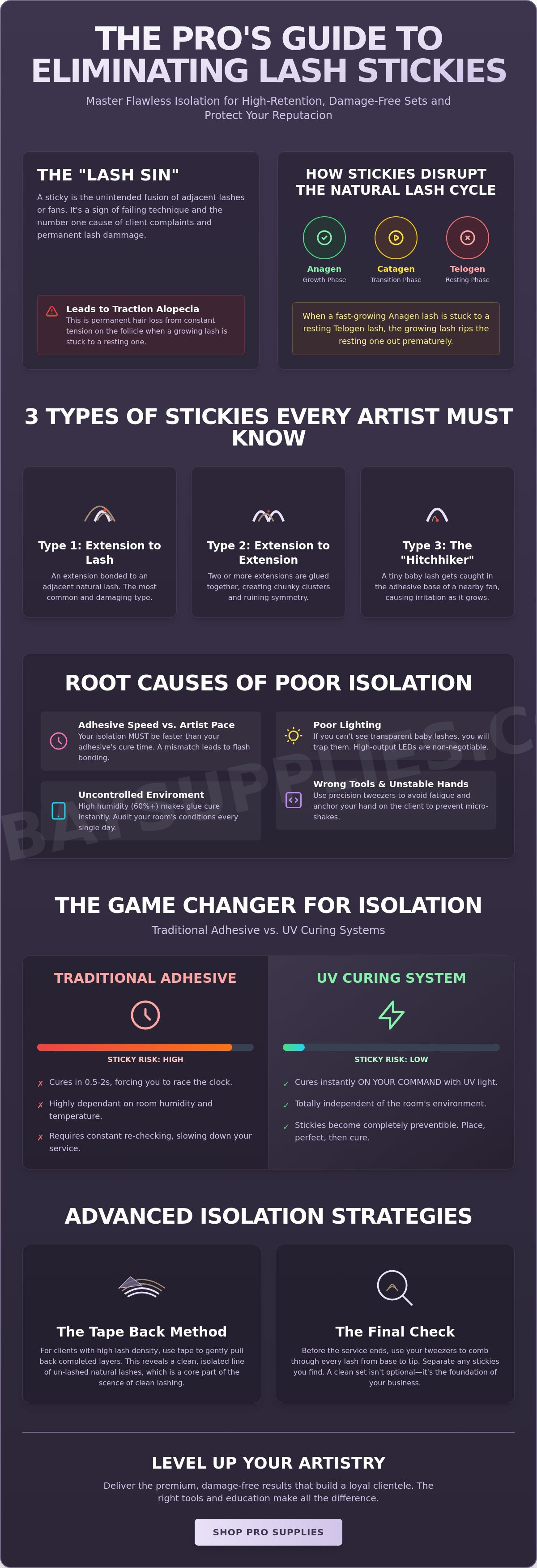
Isolation is the backbone of your brand. If you aren't obsessive about it, you aren't a pro; you're just someone playing with glue. A sticky happens when adhesive bonds things that should stay separate. It's the unintended fusion of adjacent lashes or layers that turns a beautiful set into a nightmare. Understanding how to avoid stickies in lash extensions is the difference between a client who comes back for years and one who leaves your studio in pain. We call this the "Lash Sin" because it leads directly to traction alopecia. This isn't just a buzzword. It is permanent hair loss caused by constant tension on the follicle. Your reputacion depends on this technical precision.
Your clients' lashes are always in different stages of life. You have the Anagen (growth), Catagen (transition), and Telogen (resting) phases. When a fast-growing Anagen lash is stuck to a resting Telogen lash, the tension is brutal. The growing lash will literally rip the resting one out before it's ready. This disrupts the natural cycle and leaves gaps that might never grow back. While the History of eyelash extensions shows how far we have come, the fundamental rule of one-to-one isolation remains the industry gold standard. A set is only as good as its isolation. Period.
The Three Types of Stickies Every Artist Must Know
Not all stickies are created equal. Type 1 is the extension bonded to an adjacent natural lash. This is the most common and causes the most dammage. Type 2 is extension to extension. This ruins your symmetry and creates chunky, heavy clusters that look cheap. Type 3 is the "hitchhiker." This is when a tiny baby lash gets caught in the adhesive base of a nearby fan. These are hard to see but cause immediate discomfort as they grow. Mastering your tecnique means checking for all three before your client opens their eyes.
The High Cost of Poor Isolation
Poor isolation is a business killer. When lashes are stuck together, they pinch the eyelid. It hurts. Your client won't tell you while they're on the table, but they'll feel it the next morning. This leads to negative reviews and a total loss of word-of-mouth growth. Amatures might get away with it once or twice. High-end professionals know that one bad experiense can ruin a local reputation. If you want to charge premium prices, you have to deliver premium safety. Clean sets aren't optional. They are the foundation of your empire.
The Root Causes: Why Your Isolation is Failing in the Treatment Room
Your isolation isn't failing because you're bad at your job. It's failing because you're fighting the laws of physics and chemistry. If you want to master how to avoid stickies in lash extensions, you have to stop guessing. It is about the brutal sync between your hands and your glue. If your adhesive cures in 0.5 seconds but your isolation takes two, you aren't just slow. You're creating a graveyard of stickies. The glue is drying before you even land the extension, leading to poor bonds and flash bonding with neighbors. You need to audit your enviroment every single morning.
Adhesive Speed vs. Artist Pace
Matching your adhesive to your manual speed is the first step toward mastery. If you're using a mega-fast glue in a room with 60% humidity, that adhesive is curing the moment it hits the air. This causes wicking and premature drying. Wicking is the upward travel of wet adhesive along the lash shaft. While following FDA safety requirements for lash adhesives is vital for long-term client health, understanding the chemical behavior of your glue is what saves your daily sets. Don't be the artist who floods the base because they think more glue equals better retention. It doesn't. It just equals more stickies.
Lighting is another silent killer in your studio. If you can't see the transparent baby lashes, you will trap them. It's a guarantee. You need high-output LEDs that expose every single hair from the inner corner to the outer wing. Don't be an amature who works in the dark and wonders why their sets look clumpy after three days. If you can't see it, you can't isolate it.
Mechanical Failures: Tweezers and Hand Placement
Mechanical failures are often overlooked but easy to fix. Your tweezers are an extension of your hands. If you don't have the right precission, you're just stabbing at the air. Using the right lash tweezers for your specific hand shape ensures you have the grip needed for clean separation without hand fatigue. Your hand stabilitie is also key. If you aren't resting your pinky or palm correctly on the client's forehead, your micro-shakes will ruin your work. You need a solid foundation for every single placement.
Leveling up your technic requires the right tools and a deep understanding of your space. Grab some high-quality gear and watch your application speed double as your sticky count drops to zero.
Traditional Glue vs. UV Technology: A Game Changer for Isolation
Traditional adhesive is a gamble. You're at the mercy of the air. If you want to know how to avoid stickies in lash extensions, you have to realize that moisture-based curing is inherently risky for high-speed artists. When you use traditional glue, you are waiting for a chemical reaction that you can't see or fully control. UV tecnology changes the rules of the game entirely. It moves the power from the atmofere back into your hands. This is the tech leap that separates the survivors from the masters.
Why Traditional Adhesive Invites Stickies
Traditional cyanoacrylate requires moisture to cure. This creates the "waiting game." You place a fan, and for those next few seconds, that glue is still wet. If your isolation slips or the client's eye twitches, that fan leans. It touches the neighbor. Boom. You have a sticky. High humidity makes it worse by causing shock curing or blooming, which turns the glue white and brittle. If you aren't ready for the tech shift, you should at least be using the best eyelash glue to maintain some level of control over your sets. Without the right bottle, you're just fighting a losing battle against the weather.
The UV Revolution: Total Control Over the Bond
The LivBay UV system is the ultimate insurance policy against isolation failures. It provides an imediate cure that traditional glues just can't match. You isolate. You place. You hit the light. In 1 to 3 seconds, that bond is 100% cured. There is no flash bonding because the glue doesn't have time to travel or "wick" onto neighboring lashes. You don't need nano-misters or nebulizers that often add too much moisture and cause the very stickies you're trying to prevent. It is clean. It is fast. It is precise.
This isn't just a minor upgrade. It is a total shift in how we build sets. By eliminating the curing wait time, you increase your speed without sacrificing the health of the natural lash. For a deeper dive into these lash technologies, you need to understand that light-based curing is the future of the industry. It ensures a consistancy that moisture-based systems simply cannot guarantee. Every top-tier profesional is looking at UV as the solution to the sticky problem. It is about working smarter to deliver flawless results every single time.
Pro Techniques to Eliminate Stickies in Every Set
You have the gear. You have the glue. Now you need the technics to bring it all together. Mastering how to avoid stickies in lash extensions is a mental game of workflow and layering. If you are just placing lashes and hoping for the best, you are leaving your reputation to chance. We don't do chance. We do precision. These pro-level strategies ensure every set is clean, healthy, and high-retention. It's about being proactive rather than reactive.
Start with the Divide and Conquer strategy. Instead of finishing one eye at a time, work across both eyes simultaneously. This allows the adhesive on one eye to fully cure while you are busy on the other. It's a simple way to manage dry time without overthinking your humidity. Also, watch your dipping. A tiny bead of adhesive might feel secure, but a thin film is often better for avoiding the excess that leads to flooding. Use the Banana Peel test to check your bond integrity by gently tugging the extension; it should feel solid, not gummy.
The Layering Hack: Using Tape for Precision
High densety natural lashes can be a nightmare for isolation. Use sensitive tape to gently pull back the top layers of the natural lashes. This exposes the bottom layer where those sneaky baby lashes like to hide. By working from the bottom row up, you ensure no "hitchhikers" get caught in your adhesive. Undereye mapping is essential for clear visability of every growth stage during this process. It keeps your vision focused and your placement sharp.
The 5-Minute 'Search and Rescue' Audit
Never let a client leave the chair without a Search and Rescue audit. This is the gap where amatures fail and pros shine. Use your isolation tweezers to check every single lash at the end of the service. Don't just brush through them. Perform the "up-and-out" check to ensure lashes aren't stuck to the gel pad or tape. If you accidantally find a sticky, use two tweezers to create a gentle separetion. This prevents pain and protects the follicle from traction. It is the final step to a flawless set.
Your artistry deserves the best foundation. Grab the pro tools you need to execute these techniques with total confidence.
Level Up Your Artistry with LivBay Supplies and Training
You have the blueprint. Now build the house. Mastering how to avoid stickies in lash extensions isn't just about what you do; it's about what you use. Cheap glue and flimsy tweezers will betray your artistry every single time. High-quality lash supplies are the absolute foundation of a sticky-free career. You can't reach the top with amature gear that fails under pressure. It is time to invest in yourself and your kit. This is about moving beyond simple product descriptions and selling a lifestyle of success and artistic mastery. You are an insider now. Act like it.
Mastering the Craft with LivBay Education
Isolation is a high-level skill that requires constant refinement. It is arguably the hardest part of the job. Our lash extension training programs are designed to break your bad habits and build a 6-figure sucsses story. Join us for a 3-day class in Las Vegas for real-time feedback from a master artist who has seen every mistake in the book. They will watch your hands. They will fix your posture. They will ensure your isolation is flawless before you ever touch a client. This level of profesional guidance is how you move beyond basic sets. Your kit matters. A high-end kit allows you to deliver high-end results. Don't settle for less than the best.
The Full Set Mastery
Every appointment is a chance to prove your worth as an elite artist. Integrating these isolation secrets into your full set eyelash extensions workflow will change your daily hustle. You will work faster. Your clients will have a better experiense. Most importantly, you will protect their natural lash health for the long term. A high-retention empire is built on trust and tecnique. When clients know their lashes are safe with you, they become walking billboards for your brand. Prioritizing health is the smartest business move you can make. It ensures a high-retention rate that keeps your books overflowing for months.
Final push. Consistancy in your technique leads to total artistic mastery. The industry is moving fast, and UV technology is the new standard for pros who refuse to fail. Don't get left behind using outdated methods that cause clumping and pain. You are part of an elite, hardworking group of professionals. We want you to win. Shop the UV system at LivBay Supplies today and change your lash game forever. Level up. Your future self will thank you.
Take Control of Your Artistry Today
You have the roadmap to perfection. Mastering how to avoid stickies in lash extensions is about more than just steady hands; it is about using the right tools and systems. We've covered the power of UV tecnology to lock bonds instantly and the "Search and Rescue" audit that ensures every set is a masterpiece. Don't let old-school adhesive hold back your reputacion. The industry is moving at light speed. Thousands of lash artists worldwide are already switching to our innovative UV/LED systems to eliminate flash bonding for good.
If you want to refine your technique even further, our comprehensive 3-day hands-on training is waiting for you. It's time to stop worrying about stickies and start building your empire with total confidence. Your clients deserve a premium experiense every time they lay on your table. Maintain your consistancy and never settle for being an amature. You are built for this success.
Ditch the stickies and upgrade to the future with the LivBay UV Lash System!
Frequently Asked Questions
How do I check for stickies at the end of a lash appointment?
Use your isolation tweezers to lift and separate every single lash at the end of the service. Don't just brush through them. You realy need to look at the base of every fan to ensure nothing is fused. Perform the "up-and-out" check to see if anything is stuck to the neighbor or the gel pad. It's the only way to guarantee a clean set.
Can stickies cause permanent damage to my client's lashes?
Yes, stickies cause traction alopecia by pulling lashes out of the follicle before they are ready to shed naturally. When a fast-growing lash is stuck to one in the resting phase, the tension is brutal. This can lead to permanant gaps in the lash line if the follicle is damaged over time. Protecting the natural lash cycle is your primary responsibility as a professional.
Does UV lash glue prevent stickies better than traditional glue?
UV technology is the ultimate solution for how to avoid stickies in lash extensions because it cures imediately on command. Unlike traditional glue that stays wet for several seconds, UV adhesive locks the bond the moment the light hits it. This eliminates flash bonding and wicking. It gives you total control over the curing process regardless of your room's humidity or temperature.
What are the best tweezers for isolating difficult baby lashes?
High-precision isolation tweezers with a fine, sharp tip are essential for finding those tiny baby lashes. You need a tool with perfect precission and tension that doesn't strain your hand during a long set. Look for tweezers specifically designed for deep isolation to ensure you can reach the inner corners with ease. Your tools are an extension of your hands.
How much adhesive should I actually be using to avoid flooding?
You only need a tiny micro-bead or a thin film of adhesive on the base of the extention. Flooding the lash with too much glue is a common mistake that leads to instant stickies. If you see a visible glob of glue, you've used way too much. Precision dipping ensures a clean bond without the excess travel that ruins your isolation. Less is more for clean, high-retention work.
Why are my lashes sticking to the gel pad or tape during the set?
This usually happens when you place the extension too close to the skin or use too much adhesive. If the glue is still wet when it touches the gel pad, it will bond. Check your placement height and ensure there is a tiny gap between the lash base and the eyelid. Keep your adhesive amount under control to avoid this mess.
How do I separate a sticky without hurting the client?
Use two pairs of tweezers to gently peel the lashes apart from the base upward. Never pull or yank. If the bond is too strong, use a tiny amount of de-bonder on a micro-brush to break the seal safely. Slow and steady is the rule here. You want to avoid any discomfort or pain for your client during the separation.
Is it normal to find one or two stickies in a full set?
It is common for even experienced artists to find a sticky during a set, but it shouldn't be "normal" to leave them. Part of mastering how to avoid stickies in lash extensions is the audit process. Finding them during your final check is fine. Leaving them to cause damage is a failure. Always perform your final Search and Rescue before finishing.